Alchemy Playbooks: Enterprise AI Operating System Architecture

The architecture question
most AI strategies skip.

Every organisation can point to the AI tools it has bought. Almost none can draw the system those tools now sit inside. This is the reference architecture for the layer in the middle: the one deciding, right now, whether your agentic AI is safe to run.

$9–11bn
estimated global agentic
AI market size, 2026
Multiple analyst estimates, 2026
30%
of enterprise application
revenue agentic AI could hold by 2035
Gartner, 2026
50%
of deployed AI agents still run
in isolated silos, disconnected
Salesforce Connectivity Report, 2026
25%
of 2026 security breaches linked
to AI agent misconfiguration
Industry estimate, 2026

Three layers.
One layer that actually matters.

Most of the vendor conversation about agentic AI happens at the top of the stack: the models, the agents, the copilots. Most of the boardroom conversation happens at the bottom: the ERP, the CRM, the finance and HR platforms that already run the business. Almost nobody is talking about the layer in between, which is where the actual risk is accumulating.

The Enterprise Applications layer is your existing systems of record: M365, your ERP, your CRM, your finance and HR platforms. Nothing about agentic AI should move this layer. It is the substrate everything else runs on top of.

The AI Services layer sits at the top: the models, the tools, and the data pipelines that provide the reasoning. This is where most procurement conversations, and most vendor pitches, currently live.

The AI Governance layer sits in the middle, and it is doing the real work: identity and access, policy enforcement, monitoring, compliance, and the human-in-the-loop controls that keep autonomous agents inside boundaries you actually chose. It's the orchestration tier connecting what your AI can do to what your business systems are allowed to let it do.
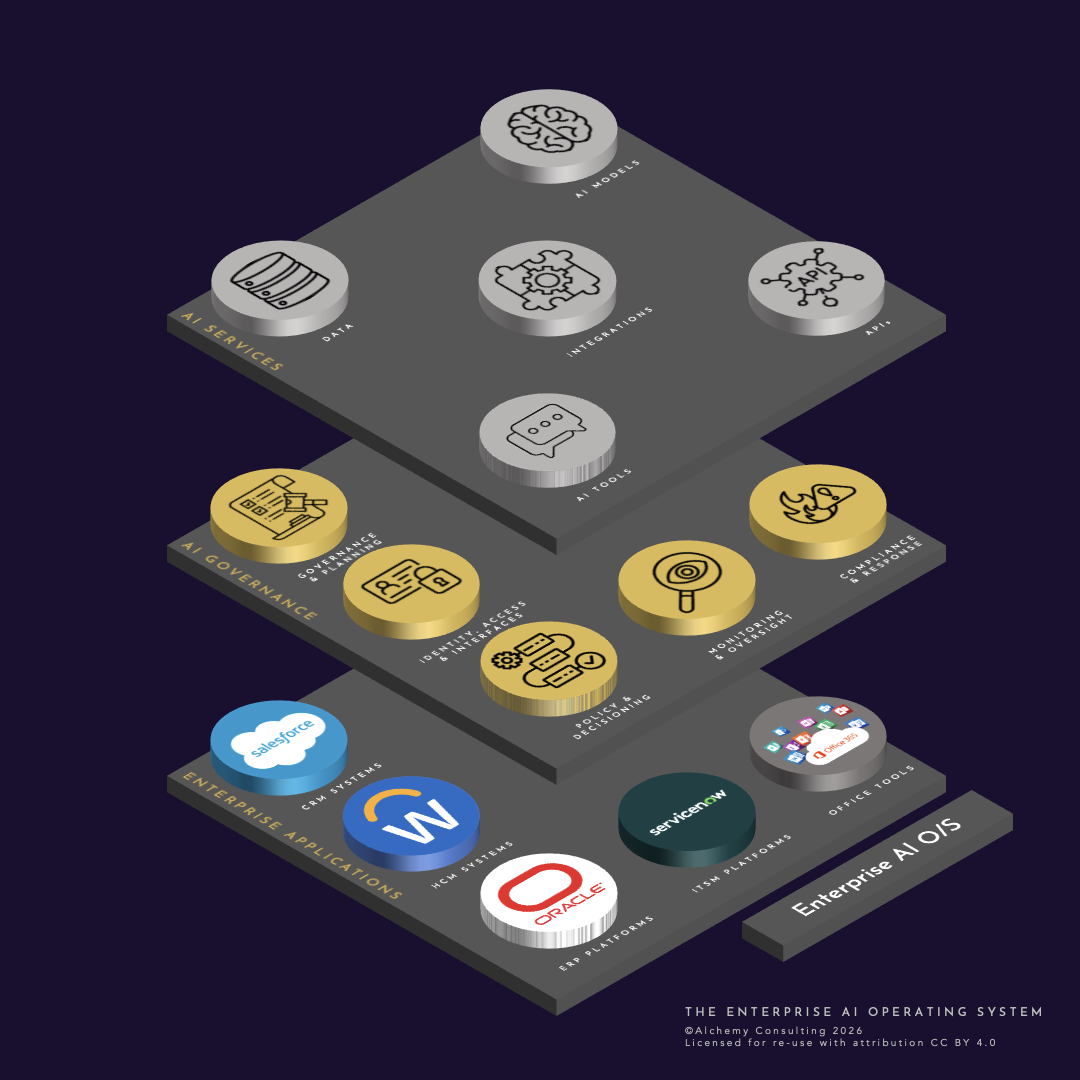

The Enterprise AI Operating System Download as PNG
Free to use and share. Please attribute using the HTML snippet below:
The <a href="https://alchemy.consulting/enterprise-ai-operating-system-architecture">Enterprise AI Operating System Architecture</a>, by <a href="https://www.david-viney.me/">David Viney</a>, licensed under <a href="https://creativecommons.org/licenses/by/4.0/">CC BY 4.0</a>

Five capabilities.
One sequence.

"AI governance" is one of the most over-used and under-defined phrases in enterprise technology right now. Inside the middle layer, it breaks down into five distinct capabilities, run in a fixed sequence.

01
Define: Governance & Planning
What are the rules, and who's accountable?

Model inventory, risk classification, explainability standards, vendor governance strategy, and the AI risk framework itself. Without this, you cannot govern what you cannot see, and most organisations start further down the sequence than this.

02
Access: Identity, Access & Interfaces
Who, and what, is allowed to act?

Identity and access management, role-based controls, API boundaries, data access controls for sensitive information, and, specifically for agentic AI, agent identity: what an autonomous agent is actually permitted to do on your behalf.

03
Control: Policy & Decisioning
What's allowed to happen in real time?

Lifecycle enforcement, explainability requirements, vendor policy enforcement, data usage rules, human-in-the-loop triggers, and risk-based decisioning. This is where most organisations currently have their biggest gap: the point where governance should become automated and enforceable, and mostly isn't yet.

04
Observe: Monitoring & Oversight
What's actually happening?

Drift detection, explainability tracking, vendor performance monitoring, data quality and lineage, user interaction monitoring, risk indicators. A great deal of enterprise investment goes into the dashboards here; far less goes into connecting them to automated enforcement back in Control.

05
Prove: Compliance & Response
What do you do about it, and can you show your working?

Lifecycle audits, explainability evidence, supplier compliance, data lineage and GDPR alignment, incident response, regulatory reporting. This is where ISO/IEC 42001 compliance ultimately lands, and where an auditor, a regulator, or a board will eventually ask you to point.

Define → Access → Control → Observe → Prove. An architecture that can demonstrate that chain end to end, with evidence at every stage, has genuine governance. One that can only show parts of it is process theatre with a dashboard attached.

The unified mapping:
five capabilities, six domains.

Architecture tells you where controls live. The MASTER-AI ™ framework tells you what those controls have to achieve. Cross-reference the two and you get a working map of the governance layer, simplified here for the web and illustrative of the pattern we see across most enterprise AI estates.

Capability MASTER
Define
Access
Control
Observe
Prove
Strong coverage Partial coverage Typically absent M A S T E R = MASTER-AI ™ domains

Reading the table by row tells you what each governance capability has to deliver across every domain. Reading it by column tells you which capabilities carry each domain. In practice, one column is consistently the sparsest: Engaged Humans (E). Vendors build almost no tooling for it, boards rarely ask about it, and it is where AI governance most often fails in the organisations we work with.

The next 12–18 months
are hard to reverse.

Sequence Discipline
Start at Define, not Control

Most organisations buy Policy & Decisioning tooling (guardrails, monitoring dashboards) before they've done Governance & Planning (a model inventory, a risk classification, clear accountability). That's backwards. You can't enforce policies against risks you haven't classified, for systems you haven't documented.

The Biggest Gap
Column E is where governance fails

AI literacy, escalation pathways, and a culture where people feel able to challenge an AI output are organisational design work, not software procurement, and they happen to be where regulation places some of its clearest obligations.

Platform Strategy
Agnostic above, opinionated in the middle

The emerging architecture is multi-model and multi-vendor by default. Stay flexible at the AI Services layer. Be deliberate and consistent about what runs in the Governance layer, because that's the layer you can't afford to improvise.

The Real Bottleneck
Fix trusted data before you scale

Agents are only as good as the data they can reach. Most organisations report that outdated data architecture, not model quality, is what's actually holding back safe agentic deployment. Fix column T before you lean on column R.

The architecture is the skeleton. The MASTER-AI domains are the organs. The controls in the middle layer are the muscles that make it move safely.
David Viney, Catalyst Newsletter, 2026
3
layers in the reference architecture: applications, governance, services
5
governance capabilities running in a fixed sequence
6
MASTER-AI ™ domains every capability has to satisfy
1
sequence that matters: Define → Access → Control → Observe → Prove

From reference architecture
to your as-is, and your to-be.

A reference architecture is only useful once you know where your organisation actually sits against it. That's the job of the Technology & AI MOT: a fixed-price, six-domain diagnostic that maps your existing systems, your AI services, and, most revealingly, what's really running in the governance layer between them, versus what the board assumes is running there.

01 · Baseline
Map your three layers as they actually exist

Not as a vendor deck describes them. What's really running in Applications, Governance, and Services today, including the shadow AI most organisations haven't inventoried.

02 · Gaps
Score the five capabilities against MASTER-AI

Using the unified mapping above as a working tool, not a slide, to find out exactly where your organisation's Column E is, because it's rarely where people expect.

03 · To-Be
A target architecture and a sequenced roadmap

One that removes duplication, closes the highest-risk gaps first, and doesn't ask you to fix everything at once.

04 · Delivery
Hand it over, or stay to run it

As Fractional CIO or Fractional CAIO, I can hand the roadmap to your existing team, or stay on to deliver the programme myself.

David Viney, Fractional CIO and AI Transformation Director

David Viney is a Fractional CIO and AI Transformation Director who built WPP Open, a $350m agentic AI platform, and has led enterprise technology at the BBC, Arup, BSI, Heathrow, and WPP.

He developed this architecture, and the MASTER-AI ™ framework behind its governance layer, from delivering agentic AI programmes inside large, regulated organisations, not from a vendor whitepaper. He serves on the AIGAS (AI Governance Standards) board and is engaged with the LBS Data Science & AI Institute on AI strategy and organisational change.

ACA, ICAEW Chartered Accountant
CITP, BCS Chartered IT Professional
Board Member, AIGAS (AI Governance Standards)
Built WPP Open, a $350m agentic AI platform

Draw your own architecture
before someone else assumes it.

Every agent you deploy, every model you connect, and every vendor you onboard without a governance layer in place adds to a liability you'll eventually need to unwind. Get the architecture right first, and the AI strategy conversation gets a great deal easier.

See also: AI Strategy & Governance FAQ and the MASTER-AI ™ framework that underpins the governance layer above.

Technology MOT · Fixed Price
Book a Technology MOT
Six domains · £5,950 + VAT · No ongoing commitment
An honest as-is / to-be read on your AI architecture
Rate: £1,200/day · Fractional, advisory, and project engagements
Based in Esher, Surrey · Working across the UK and internationally
The Enterprise AI Operating System Architecture is licensed under CC BY 4.0 · Part of the Alchemy Playbooks