29% of organisations have seen a material return from generative AI. 75% of leaders admit their AI strategy is more about signalling than substance. The Value Flow Sankey ™ is a single-page model that aligns every pound of AI investment to the benefit it delivers — so your board sees the case, challenges it, and can't easily take it apart.
Money — like energy — can be neither created nor destroyed. Sankey diagrams are a data visualisation technique that shows the major flows within a system, and how a property (in this case, money) changes state over time. The states being connected are called nodes; the connections are called links.
The Value Flow Sankey ™ is a modern descendant of the Benefit Dependency Network (BDN), originally developed at Cranfield University — a model that traces how investments generate value, from drivers for change through to delivered benefits. Unlike the old BDN, the Sankey starts with benefits on the left — because most people in the West read left-to-right, and because the artefact should say "this programme is benefits-led" before a single word is spoken.
In the middle sit the costs — split by Capex and Opex, grouped into build components. On the right, these regroup into the recognisable products being shipped. At a glance, you can see the expected return — the gap between the level of benefits and the level of costs — over a five-year horizon.
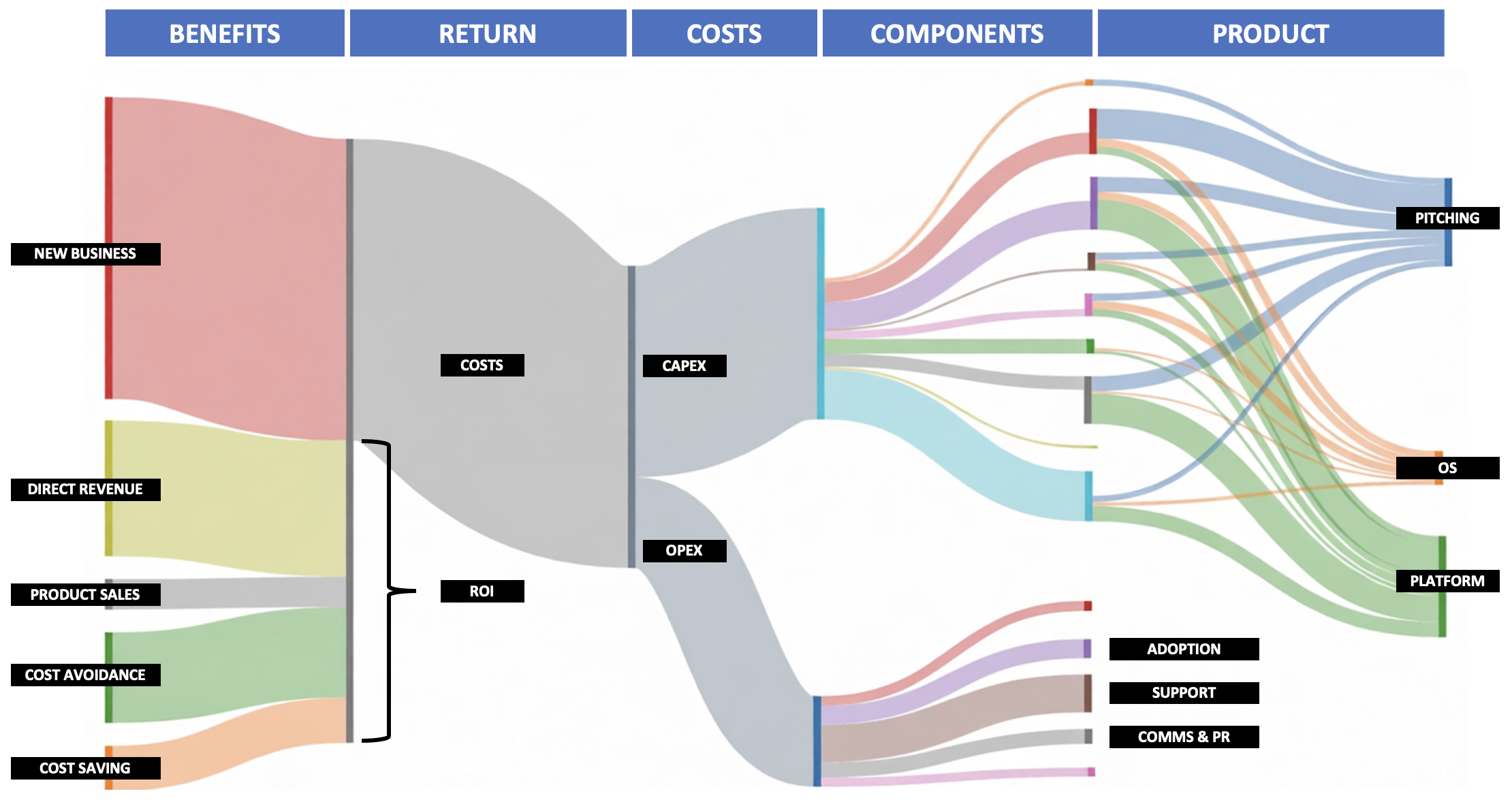
The model starts with benefits because the programme is benefits-led — and the artefact should say so before anyone reads a word. This is the reverse of the old BDN, and it's a deliberate signal to every stakeholder who looks at it.
Costs sit in the middle, split by Capex and Opex and grouped into the build components that deliver them. This is where the investment case lives — and where the gap between cost and benefit becomes the visible, defensible ROI.
On the right, build components regroup into the products being shipped — the things the organisation recognises and can track. Every individual can see a direct line of sight from their work to the benefit it delivers.

I once led the build-out of an end-to-end, AI-powered Operating System in one of the world's largest and most complex businesses — over 300 individual agencies, each defending their own budget and tools. A financial challenge was on the table, and the programme was a legitimate target. The first move was to go directly to the senior Finance leaders and remake the entire investment case afresh, in front of them.
We highlighted the recent must-win bids we had lost on the grounds of non-joined-up technology — making the cost of the status quo visible and specific, not abstract.
We showed every agency leader how they personally could save money by eliminating duplicative spend — turning sceptical stakeholders into advocates for the platform that would let them stop paying for the same thing six times over.
The smartest move: representing the entire investment budget fully aligned to benefits, some already achieved. When stakeholders challenge the case, the Sankey becomes a sophisticated Jenga Tower. Want to remove £X of cost? Tell me which £Y benefit you don't want — I know exactly which brick to pull. Pull too many, and the whole proposition visibly falls.
The basic problem with an AI case is as old as the hills: the main benefits will be indirect rather than direct — minutes saved here, friction removed there — not a single line item a CFO can trace to the bottom line. The answer isn't to find one big number. It's to build a wall so long and so provable that even a doubting Thomas can't dismiss all of it.
A low-cost test of the basic tools, with a representative sample of your workforce. This is where the wall of benefits begins to take shape — small, specific, and grounded in real usage rather than vendor projections.
Get each person in the pilot to estimate how much time they saved across a range of different tasks, from using the technology. Itemise — and ideally there should be hundreds of individual tasks, not a handful of headline ones.
Get reliable data on your average salary costs across different parts of the workforce and different locations. This converts time saved into a defensible monetary figure — the bridge between "minutes" and "money" that sceptical finance leaders need.
Multiply the salary bill by the time savings from the survey, task by task. It would be a brave stakeholder who dismisses 100% of hundreds of individually-evidenced benefits — and believing only 99% of them is usually enough for the case to fly.
A benefit tracking worksheet lists the entire wall of benefits, with columns for who owns each benefit, when it will be delivered, and how it will be evidenced. The single most important thing is a filing system of sign-off from accountable benefit holders — file notes, emails, management accounts. Benefits always get challenged, sometimes by the person who first said they were achieved. Diligently curated evidence is more than half the battle, because most organisations don't bother at all.
Working with your leadership team to map benefits, costs, and components into a single-page model — the artefact that anchors the business case and every conversation that follows it.
A structured pilot with a representative sample of your workforce — time survey, cost-of-labour data, and extrapolation — to build the evidenced wall of benefits behind the model.
I work alongside you in the room — presenting the model to senior Finance and the board, and stress-testing it so it survives the Jenga Tower test before anyone else gets to try.
Setting up the benefit tracking worksheet and sign-off process — so achievement is evidenced as it happens, not reconstructed under challenge eighteen months later.
David Viney is a Fractional CIO and AI Transformation Director with over 25 years' experience leading enterprise technology and transformation programmes at the BBC, Arup, BSI, Heathrow, and WPP — where he built WPP Open, a £250m agentic AI platform.
He developed the Value Flow Sankey ™ from the Benefit Dependency Network he worked on with Cranfield University in the early 2000s — evolving a twenty-year-old model for a world of agile, cloud, and AI-driven delivery. The original investment case using this model delivered $40m of additional margin contribution in its first year alone.
He holds ACA (ICAEW) and CITP (BCS) qualifications and has served as a board trustee in the human rights and international development sectors for over a decade.
The basic problem with an AI business case is as old as the hills — and so is the solution. Align every pound to a benefit. Build the wall. Evidence it as you go. If you'd like to talk through where your organisation stands, and what you need to make that all-important business case, I'm happy to have that conversation.