Every AI programme dips before it rises. The question is not whether — it is how deep, how long, and how much it costs you. This is a practical framework for boards and senior leaders who want to govern that dip rather than be ambushed by it.
First described by David Viney in 2005 and most recently formalised in a 2026 SSRN preprint, the J-Curve of Change describes the characteristic arc of organisational performance during technology-driven transformation. It has since been adopted by practitioners across construction management, healthcare, and agile software development.
Applied to AI, the framework is more relevant than ever — and the stakes are materially higher. The dip is not a sign of project failure. It is a structural feature of transformation. The organisations that mistake the dip for failure and abandon their programmes are the ones that bear all the cost and capture none of the benefit.
Goldman Sachs projects the AI returns phase for 2026–2028. Leaders who understand the J-Curve will position their organisations to be at the inflection point when it arrives — not starting over.
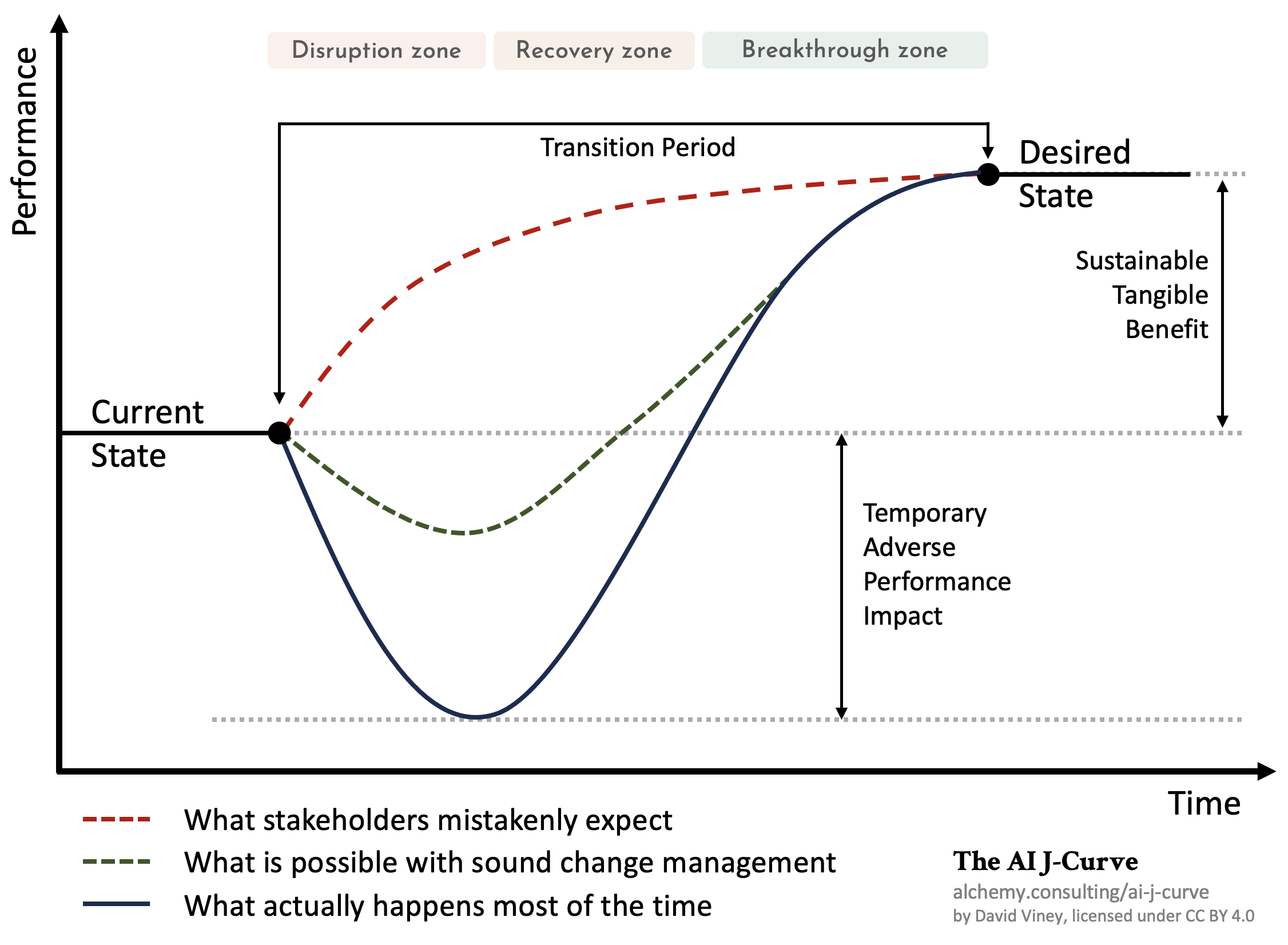
Without board-led governance and a structured change management response, AI programmes dip deeply and stay there. Pilots proliferate. Transformation stalls. Costs accumulate with no return. This is the blue curve — and it is where most organisations find themselves today.
With the right governance, sequencing, and change interventions in place, the dip is materially shallower and the recovery faster. The inflection arrives at 12–24 months from genuine implementation — not pilot — for organisations that treat the change challenge with the same rigour as the technical one.
Boards and investors routinely expect linear improvement from day one. Managing this expectation gap is not a soft communications exercise — it is a governance obligation. Premature abandonment of programmes is the single most expensive AI mistake an organisation can make.

Before any intervention, you need an honest read of your current position. Are you at the top of the first incline — transfixed between anticipation and fear? Deep in the productivity dip? Approaching the inflection? The right action depends entirely on where you are.
Most boards treat the dip as an abstract risk. I put numbers on it — lost productivity, failed implementations, change fatigue, and the opportunity cost of delayed benefit realisation. Once quantified, the investment case for active mitigation becomes straightforward.
Conventional change management toolkits were designed for a different era. AI requires board-led governance, holistic operating model redesign, and responsible AI frameworks — applied at a higher order of magnitude than most organisations are currently considering.
The inflection point arrives at 12–24 months from genuine implementation for organisations doing it well. I work alongside boards and executive teams to maintain the governance grip and stakeholder confidence needed to hold the nerve through the dip.
The J-Curve shape remains valid for AI. What is genuinely new is the conditions under which it must be navigated — and the scale of the governance response required.
Previous technology transformations were bounded. An ERP implementation changed finance. A CRM changed sales. The disruption was discrete and mappable. AI is different in kind. Agentic AI is being introduced within processes at the same time generative AI is impacting across all processes — and the manual workarounds that exist between them. The governance challenge is not that the J-Curve is deeper. It is that the transformation is happening simultaneously in multiple directions, in ways that conventional change management was never designed to manage.
Previous technology disrupted roles within functional disciplines. Same role, different tools. AI dissolves the boundaries between disciplines entirely. A marketing director with access to generative AI can produce a credible technology roadmap without involving IT. The CIO can return the favour with a go-to-market strategy requiring no input from marketing. Conventional change management assumed stable roles and structures. AI transformation is restructuring who does what — rendering role boundaries permeable or redundant — at the same time as the transition itself.
In every previous technology transformation, training was the bridge between human and tool. The direction of knowledge transfer ran one way — from trainer to trainee — and successful training produced a more capable human. AI inverts this entirely. An increasing number of implementations require users to train the technology rather than the other way around. The worker is being paid to make their role redundant. You cannot motivate user engagement with a training process that is a rational act of self-harm. This creates a change management challenge for which there is no precedent in the conventional toolkit.
A structured board-level diagnostic that maps your current position on the curve, quantifies the cost of the dip, and identifies the interventions with the highest mitigation value.
Working directly with the board and C-suite to build the AI literacy and governance capability needed to lead transformation at the required order of magnitude.
For organisations that need senior, embedded leadership — as a Fractional CIO or AI Transformation Director — to own and govern the transition through to the inflection point.
Combining the J-Curve with the MASTER-AI ™ governance framework, grounded in ISO 42001 and the EU AI Act, to deliver responsible AI transformation with board-level accountability.
David Viney is a Fractional CIO and AI Transformation Director with over 25 years' experience leading enterprise technology and transformation programmes at the BBC, Arup, BSI, Heathrow, and WPP — where he built WPP Open, a £250m agentic AI platform.
He first described the J-Curve of Change in 2005, as a framework to optimise performance during technology-driven transformation. Now commercialised as an Alchemy Playbook, it has become popular with AI practitioners, in applications as varied as public policy development (Tony Blair Institute) and investment management (PenderFund).
David serves on the AIGAS (AI Governance Standards) board and is engaged with the LBS Data Science & AI Institute on the intersection of AI strategy and organisational change. He holds ACA (ICAEW) and CITP (BCS) qualifications and has served as a board trustee in the human rights and international development sectors for over a decade.
The organisations that will emerge from the AI J-Curve dip as genuine outperformers will not be those that moved fastest. They will be those that treated the organisational challenge with the same seriousness as the technical one.